Quick identification facts
Caterpillar Type Field Checker
Use these visual checks to determine whether your caterpillar is a moth larva, a butterfly larva, or a look-alike sawfly.
Does Body Hair Indicate a Moth or Butterfly?
When you look closely at the skin of a caterpillar, hairiness is your quickest visual clue. Moth caterpillars are frequently fuzzy, hairy, or densely bristled across their bodies. If you find a caterpillar that looks like a tiny fur coat or features thick tufts, you are almost certainly observing a future moth. This thick layer of hair provides a direct defense against predators in garden environments.
Butterfly caterpillars take a noticeably different approach to their outer skin. Most butterfly larvae have completely smooth skin without dense hair coatings. While some butterfly species feature single spines along their segments, they lack the dense, furry coverings typical of common moth families. Observing the presence of smooth skin allows you to narrow your search quickly toward butterfly species.
You should also pay close attention to the arrangement of any surface projections. Moth caterpillars often display complex clusters of bristles or raised bumps, such as the distinct blue and red bumps found on spongy moth caterpillars. In contrast, butterfly projections are generally isolated, firm spines rather than soft tufts or spreading bristles. Checking whether hairs grow in dense clusters gives you a reliable answer.
- Dense fur, tufts, or soft fuzz point directly to a moth caterpillar.
- Smooth skin or isolated rigid spines typically indicate a butterfly caterpillar.
- Clustered bristle patches serve as a reliable moth indicator.
For the next useful comparison, see Moth Caterpillar Identification Chart: What Does It Look Like?.
How Can You Check the Legs and Prolegs?
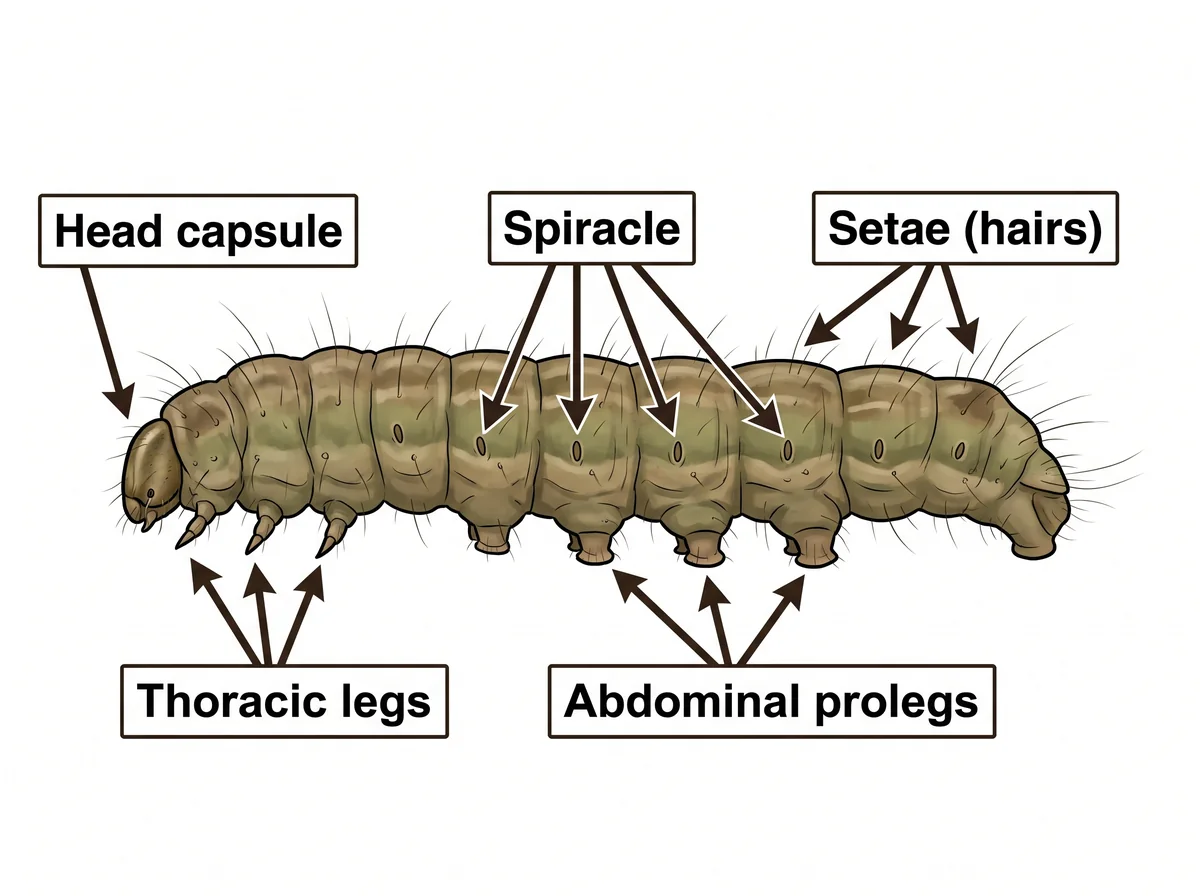
Every true caterpillar shares a specific leg arrangement that you can count directly under good lighting. True caterpillars have six jointed true legs clustered at the front of the body right behind the head. Behind these front limbs, you will see fleshy, suction-like false legs called prolegs along the abdomen. Both moth and butterfly caterpillars share this basic body plan during their larval feeding stage.
You can confirm you are looking at a true Lepidoptera larva by counting these abdominal prolegs carefully. True moth and butterfly caterpillars have five or fewer pairs of prolegs along their underside. If you count six or more pairs of prolegs, you have found a sawfly larva instead of a true caterpillar. This simple count prevents you from confusing non-moth plant pests with genuine butterfly or moth larvae.
Observing how the caterpillar grips foliage also helps you evaluate its body structure in the field. Both types use the tiny hooks on their prolegs to anchor firmly to stems while feeding on leaf tissue. When you inspect the underside of your specimen, note the clear separation between the six front true legs and the rear abdominal supports before you begin matching specific species patterns.
- Six jointed true legs sit directly behind the head on all caterpillars.
- Abdominal prolegs number five pairs or fewer on both moths and butterflies.
- Finding six or more proleg pairs reveals a sawfly larva rather than a caterpillar.
This also connects with Moth vs Butterfly Differences: What's the Difference?.
Before you choose an identification tool, Top 9 Ways to Identify Bugs In The House in 2026 can help you compare the choices.
What Distinct Markings Should You Look For?
Examining specific color patterns helps you separate major moth species from smooth garden caterpillars. Spongy moth caterpillars, for example, show a dark, blue-black hairy body highlighted by paired rows of blue and red bumps down the back. White-marked tussock moth caterpillars feature distinctive white hair tufts paired with a bold black-and-yellow body and an orange-red head that immediately stands out to your eye.
Other large moth larvae present dramatic structural growths that differ from standard smooth caterpillars. A mature cecropia moth caterpillar displays a striking blue-green body lined with prominent rows of blue, orange, and yellow protuberances topped with small black spikes. Imperial moth caterpillars showcase a dark brown body covered in fine, hair-like filaments alongside pale yellow spots positioned along their sides.
When you evaluate patterns on smooth-skinned larvae, look for uniform bands or subtle counter-shading common among butterfly species. Moth larvae are much more likely to combine bright warning colors with physical bumps, tubercles, or bristly tufts. Photographing the dorsal line and side markings of your caterpillar allows you to cross-reference these prominent features against verified species charts.
- Spongy moth larvae feature blue and red bump pairs on a dark hairy body.
- Cecropia caterpillars have bright blue-green bodies with multi-colored protuberances.
- White-marked tussock moth larvae display prominent white tufts and a red head.
Why Does the Host Plant Help With Identification?
Noting the exact plant where you find a feeding caterpillar provides essential context for your identification. Many moth and butterfly species rely on specific host plants for their nutritional needs during the larval stage. When you find a caterpillar actively chewing foliage, matching the plant species with known larval preferences helps you differentiate look-alike caterpillars that share similar base colors.
Certain moth caterpillars feed broadly across deciduous trees, while many butterfly larvae remain tied to specific herbaceous plants. By identifying whether your caterpillar is eating woody shrubs, forest canopy leaves, or garden flowers, you eliminate broad categories of potential species. Always check whether the caterpillar is solitary or feeding in large communal groups across the branches of your garden trees.
You should document both the upper and lower surfaces of damaged leaves where the larva feeds. Look for chewed margins, skeletonized leaf sections, or rolled foliage tied together with strands of silk. Combining your host plant notes with physical traits like hairiness gives you an accurate path to confirm whether you have encountered a moth or butterfly larva.
- Host plant species narrow down look-alike caterpillars rapidly.
- Feeding habits range from broad tree defoliation to specific garden flower use.
- Leaf damage patterns provide supplemental clues alongside physical traits.
For another part of the identification, open Moth Caterpillar Cocoon: What Should You Know?.
How Do Silk and Webbing Separate the Two Groups?
Silk production offers strong behavioral evidence when you are trying to distinguish moth caterpillars from butterflies. Many moth species use silk extensively during their larval stage to construct protective shelters, webbed tents, or resting mats. If you notice caterpillars living inside dense communal webbing on tree branches, you are looking at moth species like tent caterpillars or webworms.
Butterfly caterpillars rarely produce extensive web structures or large communal nests across foliage. While some butterfly larvae spin minimal silk lifelines to secure themselves against wind or predators, they do not build heavy silk coverings over entire branches. Finding thick sheets of webbing wrapped around twigs and leaves is a dependable sign that moth larvae are present in your yard.
Silk usage also carries over directly to how these insects prepare for their transformation. Moth caterpillars frequently spin thick silk cocoons among leaves, loose bark, or down in garden soil before pupating. Butterfly larvae do not spin fully enclosed silk cocoons, instead forming an exposed chrysalis. Spotting spun silk casings confirms you are tracking a moth rather than a butterfly.
- Communal web tents and branch webbing indicate moth caterpillars.
- Butterfly larvae avoid creating extensive silk foliage shelters.
- Spun silk enclosures for pupation point directly to moth species.
This also connects with Uk Moth Caterpillars: What Should You Know?.
Related identification guides
Moth Caterpillar Identification Chart: What Does It Look Like?
identify an unknown moth caterpillar using color, pattern, and hair cues organized like a chart
comparisonMoth vs Butterfly Differences: What's the Difference?
tell an adult moth apart from an adult butterfly using wings, antennae, and behavior
appearanceUk Moth Caterpillars: What Should You Know?
identify common British moth caterpillars found in gardens and countryside
life cycleMoth Caterpillar Cocoon: What Should You Know?
identify a moth cocoon and understand how it differs from a butterfly chrysalis
Frequently asked questions
Can a hairy caterpillar ever turn into a butterfly?
As a general rule, distinctly hairy or fuzzy caterpillars turn into moths rather than butterflies. While a few butterfly caterpillars possess small branching spines or sparse bristly hairs, dense fur-like coats and tufts are characteristic of moth families. If you encounter a caterpillar with a thick layer of fuzz or prominent hair pencils, you can be confident you are looking at a moth larva.
How do caterpillar legs differ between moths and sawflies?
True moth and butterfly caterpillars always have six true front legs plus five or fewer pairs of abdominal prolegs. Sawfly larvae closely resemble caterpillars in shape and color, but they have six or more pairs of fleshy prolegs along their abdomen. Counting the abdominal prolegs gives you an instant way to tell a true moth caterpillar apart from a sawfly larva.
What is the difference between a moth cocoon and a butterfly chrysalis?
Moth caterpillars typically spin a protective silk casing known as a cocoon, often blending it with leaf debris or burying it in soil. Butterfly caterpillars do not spin enclosed silk cocoons; instead, their outer skin hardens into an exposed shell called a chrysalis. If you find a pupal case wrapped in spun silk, it belongs to a moth.
Are bristly moth caterpillars safe to pick up?
You should avoid handling hairy or bristly moth caterpillars with bare hands. Many species with tufts or spines, including tussock moths, possess irritating hairs that can cause skin irritation or mild rashes on contact. If you need to move or inspect a bristly caterpillar, gently guide it onto a leaf or use a sturdy twig rather than your fingers.