Quick identification facts
Moth Caterpillar Identification Checklist
Review these visible features on your specimen to confirm whether you have found a moth caterpillar.
How Do Leg Patterns Help You Confirm a Caterpillar?
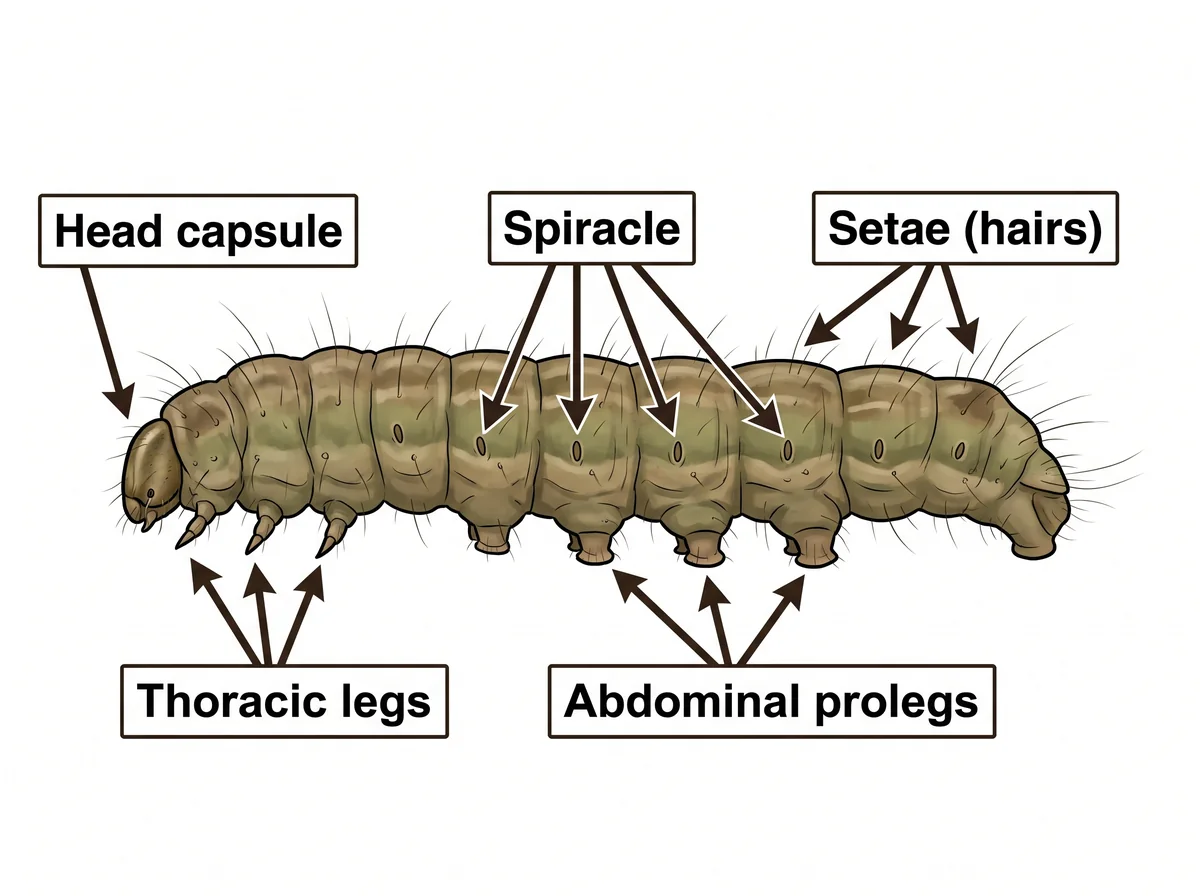
When you look at a caterpillar, start by checking its legs to confirm its general insect group. Every caterpillar possesses six true, jointed legs clustered near the front section of the body right behind the head. These true legs remain present throughout every life stage and match the six legs you eventually see on the fully grown adult moth.
Behind those true limbs, you will see a series of soft, fleshy stubs along the underside of the abdomen called prolegs or false legs. These prolegs function like suction cups to grip twigs, leaves, and bark while the insect crawls or feeds. Observing both the front legs and abdominal prolegs together lets you verify that you are looking at a caterpillar rather than a beetle larva.
Take a moment to watch how the creature moves across a leaf surface in your garden. The true legs guide its forward direction while the abdominal prolegs anchor the heavy midsection and rear end. Counting these structures helps you document essential clues if you plan to photograph the specimen for further species identification.
- Six front legs clustered directly behind the insect's head.
- Fleshy abdominal prolegs that provide grip on foliage.
- Coordinated movement between front and rear leg groups.
You can check the same detail against Appearance: What Does It Look Like?.
What Body Textures Distinguish Moth Caterpillars from Butterflies?
Moth caterpillars frequently display a covering of hair, bristles, or fuzzy filaments over their outer skin. In contrast, most butterfly caterpillars have smooth, bare bodies without heavy coats of hair. When you encounter a fuzzy or prickly crawler on a plant stem, you are almost always examining the larval stage of a moth species.
These bristly coatings vary greatly between different moth groups. Some varieties carry dense, woolly mats of soft fuzz, while others produce stiff, scattered spines or specialized raised bumps across their back segments. Examining the density and placement of these hairs gives you an immediate starting point for narrowing down the insect's family.
Be cautious whenever you observe thick hairs or spikes on a specimen in the wild. You should avoid handling fuzzy caterpillars directly with bare hands, as some hair-covered species possess irritating bristles. Simply look closely at the texture without disturbing the insect to record its visual physical features safely.
- Dense fuzz or woolly coats across the body segments.
- Stiff, erect bristles or raised spiky bumps along the back.
- Generally distinct from the smooth skin of butterfly larvae.
Which Color Patterns Mark Specific Moth Species?
Specific markings allow you to tell common moth larvae apart with confidence. For example, spongy moth caterpillars feature a blue-black hairy body highlighted by distinct pairs of blue and red bumps running down their backs. Spotting those double rows of colored bumps lets you identify that particular species almost instantly.
Other species exhibit completely different colors and ornamentations that you can compare. Imperial moth caterpillars display a dark brown body covered in fine filaments with pale yellow spots along their sides. In contrast, white-marked tussock moth caterpillars show prominent white hair tufts, a striking black-and-yellow body, and a bright orange-red head.
You might also discover large, colorful caterpillars such as the cecropia moth. A mature cecropia larva develops a soft blue-green body decorated with neat rows of blue, orange, and yellow protuberances topped with small black spikes. Noting every color combination on the body, head, and tubercles helps you pinpoint the exact moth.
- Spongy moth: Blue-black hairy body with pairs of blue and red bumps.
- Imperial moth: Dark brown body, fine filaments, and pale yellow side spots.
- White-marked tussock moth: White hair tufts, black-and-yellow body, red head.
- Cecropia moth: Blue-green body with blue, orange, and yellow spiked bumps.
Before you choose an identification tool, Top 9 Ways to Identify Bugs In The House in 2026 can help you compare the choices.
This also connects with Identification Chart: What Does It Look Like?.
What Look-Alikes Might Confuse Your Identification?
Several common caterpillars share similar colors or hairy textures, making them easy to mix up during field observations. The eastern tent caterpillar forms noticeable silk nests in tree branches and shows dark fur with light striping. You can easily confuse it with other communal caterpillars that strip foliage from shade trees.
Another species to consider is the fall webworm, which also constructs loose silk webbing over branch tips and displays pale, fuzzy bodies. Meanwhile, the mourning cloak caterpillar presents a dark, spiky form that might look like a moth larva at first glance, even though it actually develops into a brush-footed butterfly.
To separate these look-alikes, you should compare their hair patterns, background colors, and whether they form large silk tents. Looking at whether the body carries smooth skin or thick spines will prevent you from confusing a butterfly caterpillar like the mourning cloak with true moth species in your yard.
- Eastern tent caterpillar: Hairy body frequently associated with branch nests.
- Fall webworm: Pale, fuzzy appearance found inside loose tree webbing.
- Mourning cloak caterpillar: Dark spiky body that matures into a butterfly.
How Do Life Stages and Adult Traits Confirm Your Match?
Finding silk structures or observing the adult form provides final confirmation of your caterpillar's identity. Moth caterpillars build a silk-covered cocoon when preparing for pupation, whereas butterfly caterpillars harden into a smooth, exposed chrysalis. Spotting a cocoon woven from silk threads confirms that your specimen belongs to the moth lineage.
If you observe the adult stage that emerges, look closely at its head and wing posture. Adult moths typically feature feathery, thick, or comb-like antennae, whereas butterflies have slender antennae ending in distinct rounded clubs. These feathery antennae help moths detect chemical scents as they fly in search of food or mates.
Wing resting position offers another clear clue you can check easily. Moths generally rest with their wings spread flat or held tent-like across their backs, while butterflies usually fold their wings vertically over their bodies. Combining cocoon type, antennae shape, and wing position ensures you correctly identify the insect at any stage.
- Pupation occurs inside a protective silk-covered cocoon.
- Adult moths display thick, comb-like, or feathery antennae.
- Adult wings rest spread flat or draped open over the body.
For another part of the identification, open Size: How Big Is It?.
Related identification guides
Appearance: What Does It Look Like?
Understand appearance and identifying features for Caterpillar Moth
appearanceIdentification Chart: What Does It Look Like?
Understand identification chart for Caterpillar Moth
sizeSize: How Big Is It?
Understand size guide for Caterpillar Moth
life cycleBaby vs Adult: What's the Difference?
Understand baby vs adult for Caterpillar Moth
Frequently asked questions
What is the easiest way to tell a moth caterpillar from a butterfly caterpillar?
The easiest way to tell them apart is to look at their skin texture. Moth caterpillars are frequently covered in thick hair, fuzz, filaments, or bristly spines across their back and side segments. In contrast, most butterfly caterpillars have smooth, bare skin. While both types share six front legs and fleshy abdominal prolegs, heavy fuzz or bristling strongly indicates that your specimen is the larva of a moth.
How can you identify a spongy moth caterpillar by its markings?
You can recognize a spongy moth caterpillar by its dark, blue-black hairy body and the distinct colored markings along its spine. It features five pairs of blue bumps followed by six pairs of red bumps running down the length of its back. These paired colored bumps, combined with long hairs along the sides, provide an unmistakable visual clue when you inspect foliage in affected areas.
What does a cecropia moth caterpillar look like as it matures?
A mature cecropia moth caterpillar is recognized by its large, blue-green body and rows of brightly colored bumps called protuberances. Along its back, you will see pairs of orange and red bumps near the front, yellow bumps along the middle, and blue bumps near the rear and sides, all accented with tiny black spikes. Its bright coloring makes it one of the easiest moth caterpillars to identify.
How do moth cocoons differ from butterfly chrysalises?
Moth caterpillars spin a protective cocoon made of silk threads, sometimes incorporating leaf pieces, debris, or shed caterpillar hairs into the casing. In contrast, butterfly caterpillars do not spin silk cocoons; they shed their outer skin to form a bare, hard-shelled chrysalis. Finding a soft, fibrous silk structure attached to a branch or hidden among leaves confirms you are seeing a pupating moth.