Quick identification facts
Moth Caterpillar Identification Checker
Use these visual checks to narrow down the appearance and characteristics of your caterpillar specimen.
What Basic Body Features Should You Check First?
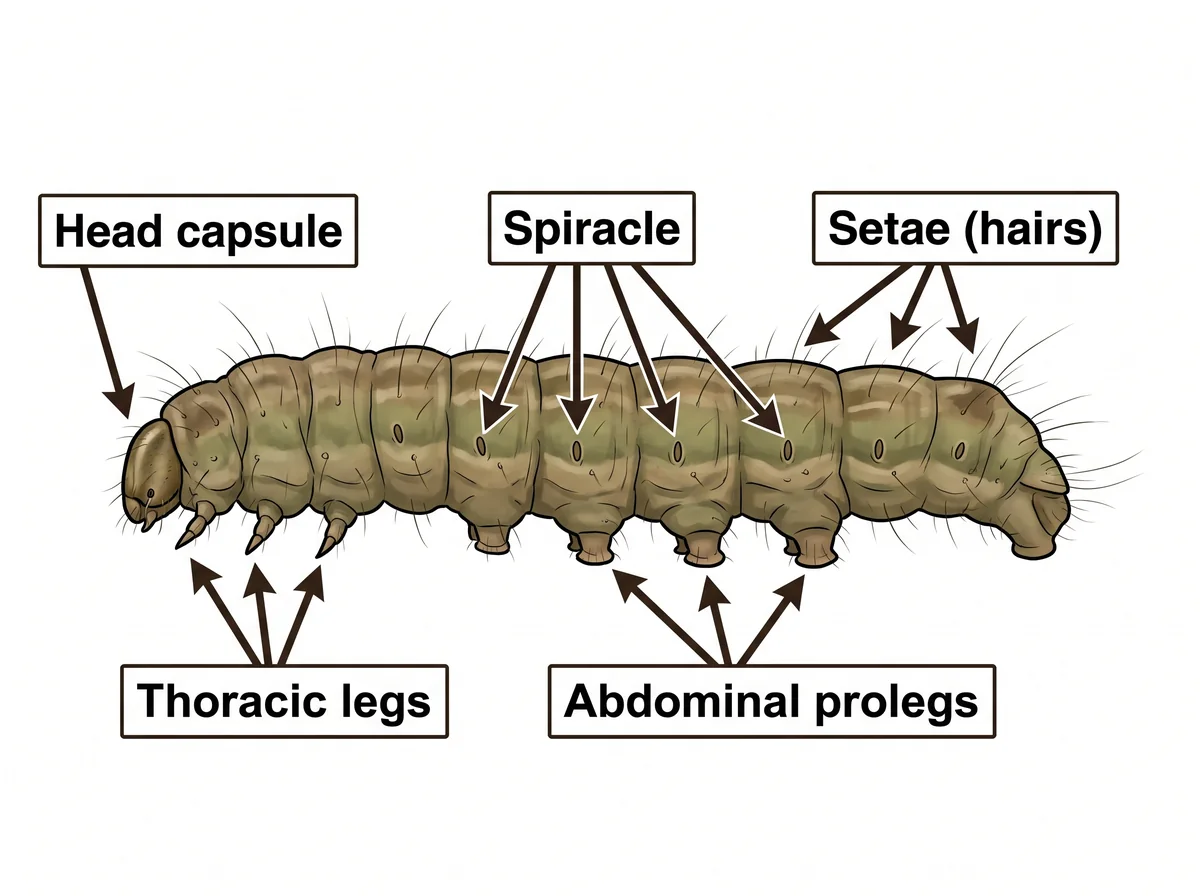
You can confirm you are looking at a moth caterpillar by checking its basic body layout before evaluating colors. All true caterpillars feature three pairs of jointed, true legs positioned near the front of the body just behind the head. Along the underside of the abdomen, you will find soft, fleshy false legs called prolegs that help the insect grip leaves and stems securely.
Texture provides your next major clue when narrowing down the insect group. Moth caterpillars are often distinctly hairy, fuzzy, or bristly, which sets them apart from the mostly smooth skin seen on butterfly larvae. Some species display dense coats of soft hairs, while others carry stiff, upright spines or prominent fleshy bumps along their back and sides.
You should also take note of how the insect rests on foliage when observed in the garden. When these larvae eventually transform into adult moths, they generally rest with their wings held flat or spread open, displaying thick, feathery, or comb-like antennae. Observing the caterpillar's present size and external bristles gives you the quickest path to a reliable species match.
- Check for six jointed true legs positioned behind the head capsule.
- Look for fleshy prolegs along the underside of the abdomen.
- Observe whether the skin surface is smooth, fine-haired, or covered in stiff bristles.
A related clue is covered in Moth vs Butterfly Caterpillar: What's the Difference?.
How Do You Identify Blue-Black or Tufted Species?
When you spot a hairy caterpillar with dark coloring, inspect the pattern of raised spots along its back. The spongy moth caterpillar displays a blue-black body covered in thin hairs, characterized by distinct paired bumps along its upper surface. You will notice five pairs of blue bumps followed by six pairs of red bumps running down the length of its spine.
A different pattern appears if your subject features bright, dense tufts alongside strong body striping. The white-marked tussock moth caterpillar stands out with an orange-red head and a striking black-and-yellow striped body. You can readily recognize it by four dense brush-like tufts of white hair standing upright along the top of its back.
Size helps separate younger larvae from mature specimens within these tufted groups. Newly hatched spongy moth larvae measure smaller than 0.25 inches, eventually expanding to 1.5 to 2 inches at full growth. White-marked tussock moth caterpillars reach roughly 1.3 inches, or 35 millimeters, maintaining their bright red head and tufted appearance throughout later stages.
- Spongy moth: Blue-black hairy body with five pairs of blue bumps and six pairs of red bumps.
- White-marked tussock moth: Orange-red head, black-and-yellow stripes, and four white hair tufts.
- Size ranges: 0.25 to 2 inches depending on age and individual species maturity.
For the next useful comparison, see Uk Moth Caterpillars: What Should You Know?.
Before you choose an identification tool, Top 9 Ways to Identify Bugs In The House in 2026 can help you compare the choices.
What Do Large Green and Spiky Caterpillars Look Like?
If you encounter a very large, brightly colored green caterpillar, check the arrangement of its raised spikes and bumps. The cecropia moth caterpillar matures into a striking blue-green body lined with orderly rows of colorful protuberances. You will see vivid yellow and orange bumps alongside blue side nodes, each tipped with delicate black spikes.
These dramatic structures make the cecropia larva one of the easiest species to separate from common garden pests. Because giant silkworm moth caterpillars can be hazardous to handle, you should avoid touching their spiky projections directly. The bright nodes serve as warning signals across the insect's wide segments as it feeds on deciduous tree leaves.
Body size offers definitive confirmation when you compare large green specimens against smaller garden loopers. Fully grown cecropia moth caterpillars reach up to 4.5 inches, or 10 centimeters, in length, ranking them among the largest caterpillars found in North America. Their substantial thickness and colorful nodes make them unmistakable even from several feet away.
- Cecropia moth: Blue-green body with bright yellow, orange, and blue protuberances.
- Spike pattern: Rows of raised nodes crowned with small black spikes.
- Mature size: Reaches up to 4.5 inches (10 cm) in total length.
How Can You Recognize Brown Filaments and British Species?
Darker caterpillars often rely on fine filaments or muted tones rather than bright warning colors. The imperial moth caterpillar features a dark brown body covered in fine, hair-like filaments and marked with pale yellow spots along its sides. Because imperial moth caterpillar hairs can cause an itchy skin rash upon contact, inspect these specimens without picking them up.
For caterpillars observed in the United Kingdom, body length and background markings guide your chart identification. The dot moth caterpillar recorded in Britain reaches lengths of up to 45 millimeters as it approaches maturity. It typically presents a robust, brownish or greenish body that blends smoothly into low-growing garden vegetation and herbaceous border plants.
Comparing side markings against back patterns helps you tell brown species apart with confidence. The imperial larva displays clear yellow lateral patches against dark skin, whereas dot moth larvae show more uniform, camouflaged shading. Always note whether the body carries long, spreading hairs or shorter, dense bristling when recording your field observations.
- Imperial moth: Dark brown body, fine filaments, and pale yellow spots along both sides.
- Dot moth: British species growing up to 45 mm with muted, camouflaged body tones.
- Surface details: Check for thin spreading filaments versus uniform body shading.
You can check the same detail against Moth vs Butterfly Differences: What's the Difference?.
Which Look-Alikes Might Confuse Your Identification?
Several common species share colors and bristly textures with the primary moth larvae on your chart. The eastern tent caterpillar displays a dark body with a solid white stripe down its back, often mistaken for spongy moth larvae. Mourning cloak caterpillars feature black bodies with tiny white specks and red spots, but belong to the butterfly family.
You might also encounter the fall webworm, a pale, yellowish-gray caterpillar with long, silky white hairs sprouting from dark bumps. While it resembles young tussock moth larvae at first glance, it lacks the four dense white back tufts and bright orange-red head capsule. Carefully checking the specific color of each bump prevents misidentifying these common look-alikes.
Keep in mind that stinging caterpillars have hollow venom-releasing bristles that cause immediate skin irritation. When you find a bristly specimen that matches multiple chart candidates, observe its feeding location and body proportions from a safe distance. Using precise color cues, such as paired red and blue nodes, quickly settles any confusion between related species.
- Eastern tent caterpillar: Features a solid white dorsal stripe without paired red and blue bumps.
- Mourning cloak: Butterfly larva with black spiny skin and reddish dorsal marks.
- Fall webworm: Covered in long silky hairs without the four compact back tufts of tussock moths.
This also connects with Us Moth Caterpillars: What Should You Know?.
Related identification guides
Moth vs Butterfly Caterpillar: What's the Difference?
distinguish a moth larva from a butterfly larva while it is still in the caterpillar stage
comparisonMoth vs Butterfly Differences: What's the Difference?
tell an adult moth apart from an adult butterfly using wings, antennae, and behavior
appearanceUk Moth Caterpillars: What Should You Know?
identify common British moth caterpillars found in gardens and countryside
appearanceUs Moth Caterpillars: What Should You Know?
identify common large North American moth caterpillars by region
Frequently asked questions
How can you tell a moth caterpillar from a butterfly caterpillar?
You can tell them apart primarily by body texture and hairiness. Moth caterpillars are frequently fuzzy, densely hairy, or armed with bristly spikes and raised bumps. In contrast, most butterfly caterpillars have smooth, hairless skin, though some may carry simple fleshy filaments. Both groups share six true front legs and abdominal prolegs, so surface texture, tufts, and paired colored bumps serve as your clearest identification clues.
What does a spongy moth caterpillar look like on a chart?
A spongy moth caterpillar is identified by its blue-black hairy body and a distinct double row of colored bumps along its back. You will see five pairs of blue bumps near the front followed by six pairs of red bumps toward the rear. Newly hatched larvae start under 0.25 inches long, while mature caterpillars reach between 1.5 and 2 inches in length.
Are hairy moth caterpillars safe for you to touch?
You should avoid touching hairy or spiky moth caterpillars with bare hands. Certain stinging caterpillars have hollow bristles that release venom upon contact, while species like the imperial moth caterpillar have fine hairs that trigger an itchy skin rash. Giant silkworm moth larvae can also cause irritation. Always photograph the caterpillar for chart identification rather than handling it directly.
How big can North American moth caterpillars grow?
Moth caterpillar sizes vary widely depending on the family and age stage. While small species or young larvae may measure less than 0.25 inches, large species reach several inches at maturity. The cecropia moth caterpillar is one of the largest North American species, reaching roughly 4.5 inches, or 10 centimeters, with a thick blue-green body and prominent colored bumps.